The Polish 6×30: A Collector's History of H.Kolberg & PZO Military Binoculars | Collectors Archive
March 18, 2026
From a Warsaw snuff-box factory to Fort Bragg trials — the remarkable story of Poland's interwar binocular, traced through serial numbers, archival documents, and surviving examples.
For collectors of interwar European military optics, few items carry as much history per gram as the Polish 6×30 prismatic binocular. Produced first by H.Kolberg i S-ka and later by PZO (Polskie Zakłady Optyczne) in Warsaw between 1922 and 1939, these instruments served as the standard-issue field glass of the Polish officer corps, competed against Zeiss at Fort Bragg, were seized by partisans from a Nazi-operated factory, and ultimately vanished across the battlefields of the Second World War. Remarkably, surviving examples can still be dated by serial number — thanks to a single wartime document that made it out of Poland.
The Roots of Polish Optics
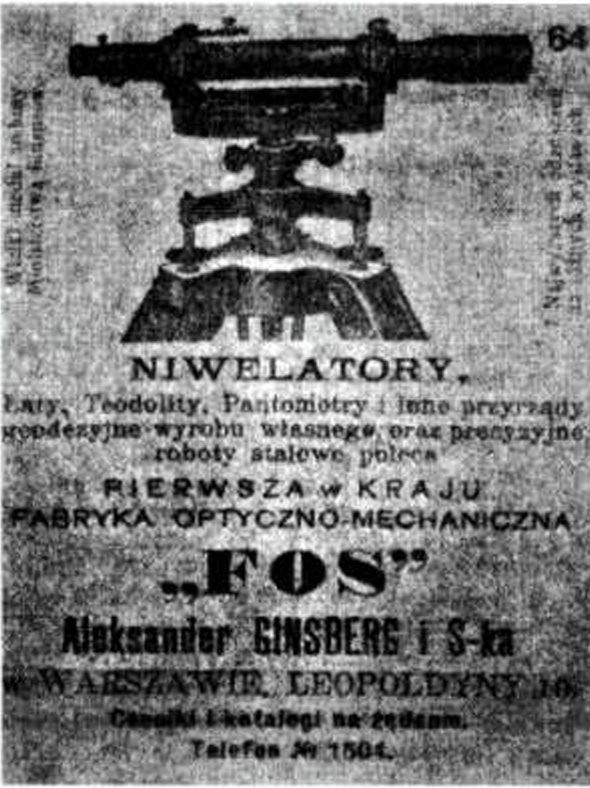
Poland's optical tradition predates its independence. While the country was partitioned between Russia, Prussia, and Austria-Hungary throughout the 19th century, several significant factories operated on Polish soil. The earliest recorded was G. Gerlach, established in 1816, which produced geodetic and drafting instruments and maintained shops in Warsaw, St. Petersburg, and Moscow. Michał Pick's optical-mechanical factory, founded in 1820, trained seventy optical mechanics from 1877 onward. Most significant was Aleksander Ginsberg's "FOS" factory, established in Warsaw in 1898 — the most dynamic optical manufacturer in the Russian Empire, producing cameras, objectives, prismatic binoculars, and military instruments before being evacuated to St. Petersburg in 1915.
When Poland regained sovereignty in November 1918, the experienced personnel from these earlier enterprises formed the nucleus of a new domestic optical industry. One of the most consequential ventures to emerge was H.Kolberg i S-ka.
The Founding of H.Kolberg i S-ka
In October 1921, Leon Małecki, Henryk Kolberg, and Kazimierz Karol Mieszczański established a limited liability company in Warsaw with a capital of 3,000 Polish Marks. By 1922, the firm had been transformed into a joint stock company — Fabryka Aparatur Optycznych i Precyzyjnych H.Kolberg i S-ka S.A. (Factory of Optical and Precise Instruments) — with Henryk Kolberg holding 40% of shares, Bank Handlowy w Warszawie holding 20%, and remaining investors holding the balance.
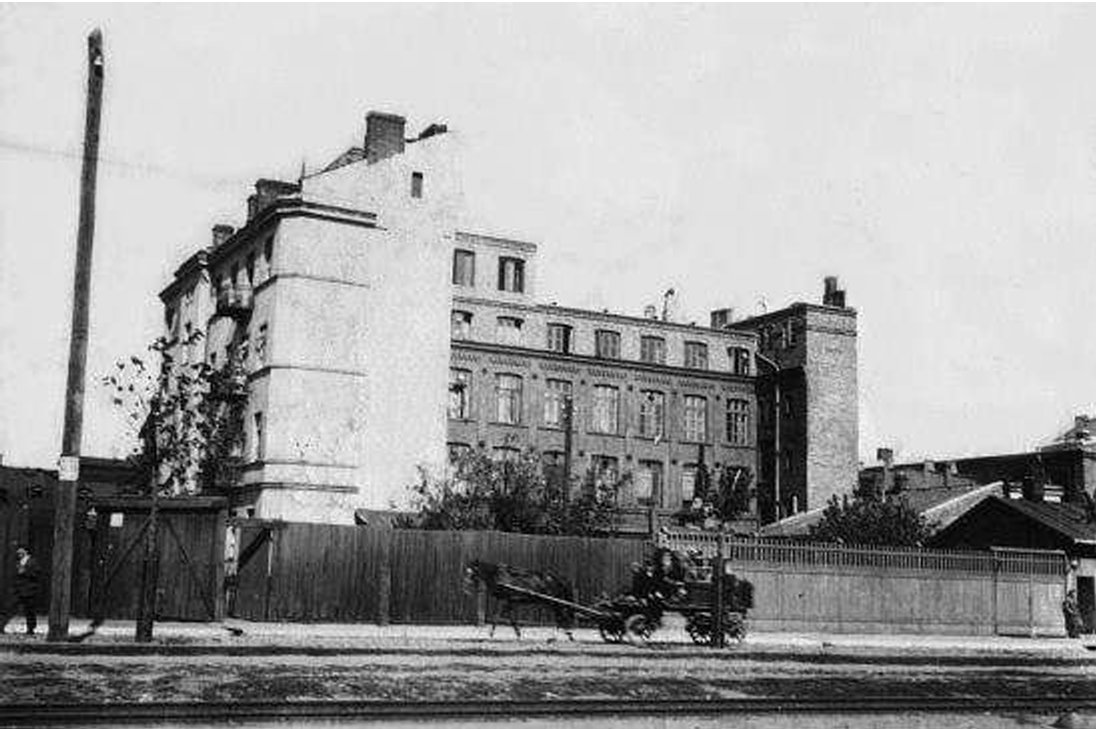
The new company immediately secured a contract with the Polish Ministry of Defence (MOD), Department III of Artillery and Armament, for the production of 1,000 prismatic binoculars. To fulfil this contract, the company acquired a former snuff-box factory — a 1,500m² building at 35 Grochowska Street in Warsaw — which would remain the company's home until 1995.
Design Origins: Russian Drawings, Zeiss Lineage
The MOD contract included a fascinating provision. Its final clause stated that to facilitate production, the Department of Artillery and Armament would lend the company construction drawings of a Russian 6× binocular (Zeiss type), requiring the company to produce two copies and return the originals within ten days. The likely instigator of this approach was M.E. K. Hercyk-Pałubiński, who had been manager of the Optical Department at Zakład Obuchowski in St. Petersburg, where this binocular model had been in production since 1907.
The chosen design was closely related to the Zeiss Silvamar. This is a significant detail for collectors: the H.Kolberg 6×30 descends from the same Zeiss-derived lineage that produced many of the most highly regarded military binoculars of the early 20th century.
An immediate challenge arose when the German manufacturer of optical element production machinery demanded a higher price than budgeted. Unable to absorb the cost, H.Kolberg petitioned the MOD to increase the contract from 1,000 to 4,000 binoculars, which was granted — enabling the factory to afford the essential German-made equipment.
Technical Specifications & Construction
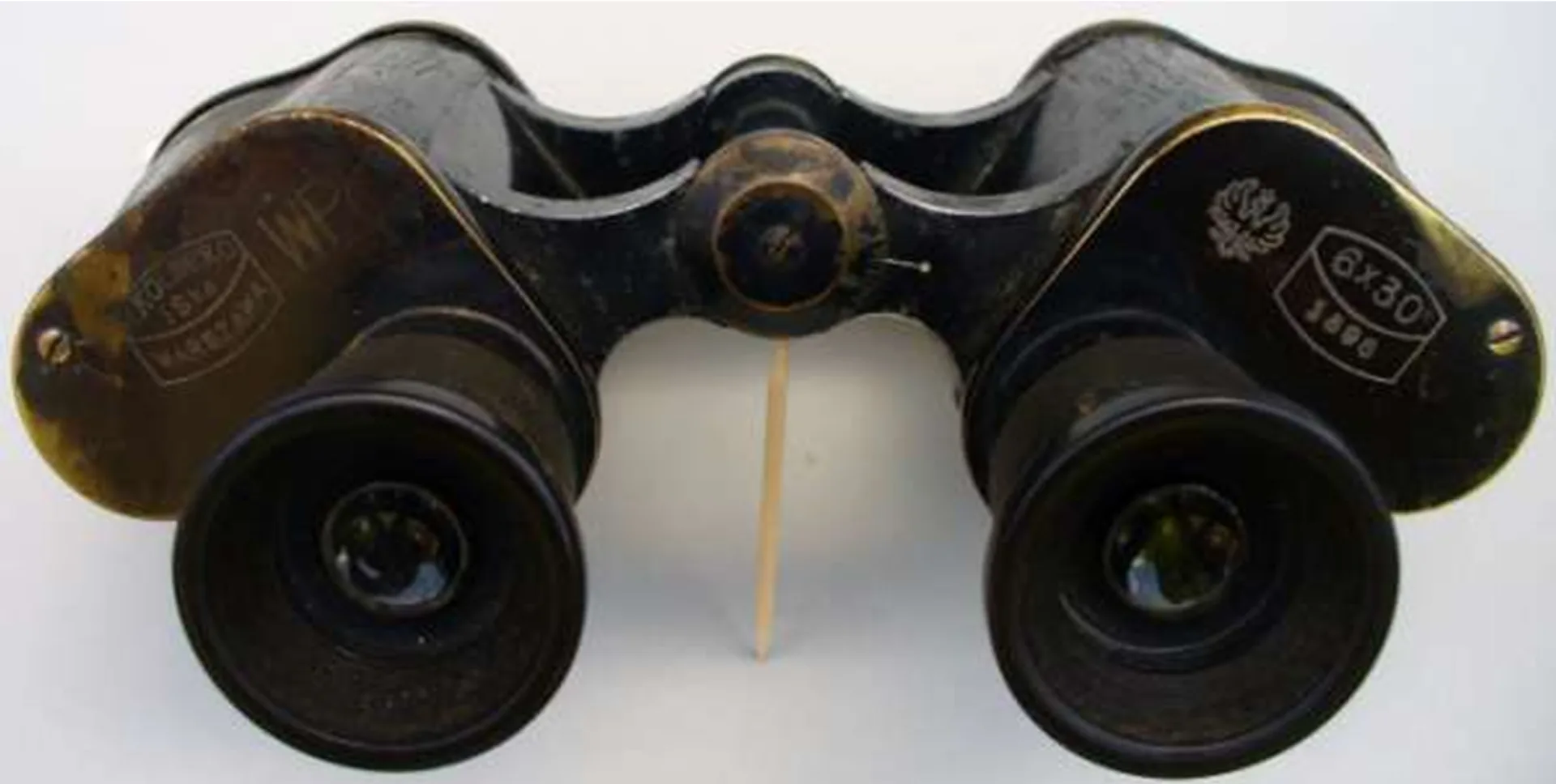
The 6×30 binocular featured Porro-type prisms, 6× magnification, a 30mm objective diameter, and a light transmitting power of 25 (exit pupil 5mm). The field of view was 150 metres at 1,000 metres distance, and the instrument weighed 653 grams without its case. Individual eyepiece focusing was employed — a feature unique in its specific implementation to H.Kolberg and PZO production, distinct from the OPW and "eug" coded wartime binoculars produced later at the same factory.
Early production bodies were aluminium sand-cast, with top and bottom prism housing cover plates of brass and brass lens tubes. The body was covered in a high-quality vulcanite plastic imitation leather that, according to the Vacani research, proved notably more durable than the covering on comparable Leitz binoculars. The common deterioration point is where the binocular was habitually held — temperature and perspiration caused the covering to harden and crack over the decades.
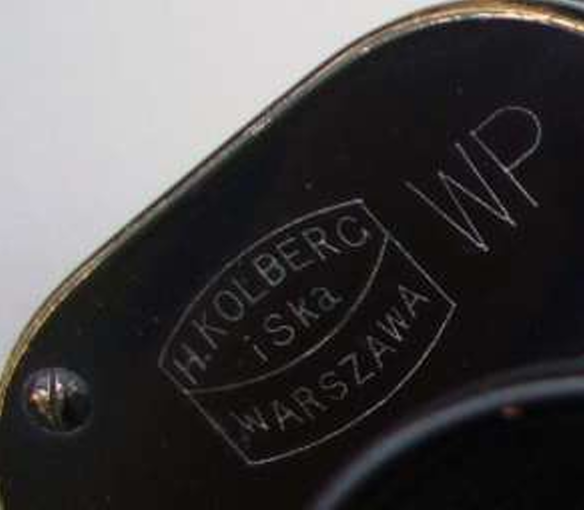
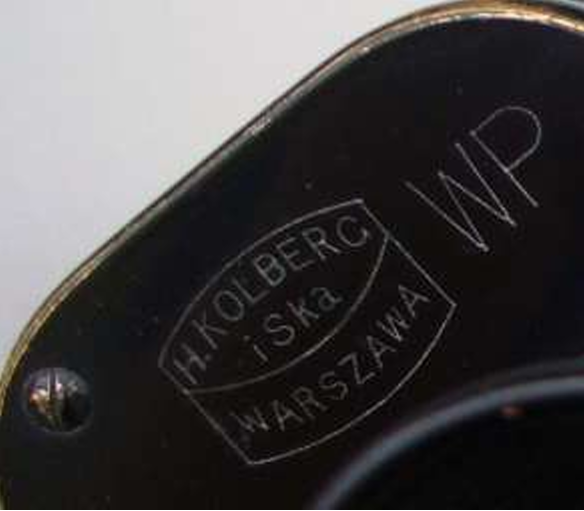
All optical elements used French glass from Parra Montois or German glass from Schott — Poland did not produce its own optical glass at this time. Markings on the left plate read "H.Kolberg i S-ka Warszawa" within an achromatic objective lens shape, while the right plate showed "6×30" with the serial number, flanked by the Polish eagle emblem and the letters "WP" — Wojsko Polskie (Polish Army).
Technical Evolution: The Misting Problem & Optical Improvements
From 1924 to 1927, the factory achieved a production rate of approximately 500 binoculars per month — sufficient to eliminate Germany's Carl Zeiss as the primary supplier. (The last import contract, for 2,000 Zeiss Silvamar binoculars at $24.40 each, was signed in August 1924.) However, production slowed significantly in 1928 due to an interior fogging problem — 1,618 units were produced in 1927, but only 1,163 in 1928.
Interior "misting" of lenses and prisms was a widespread issue across optical factories of the period. A factory representative, M.E. T. Malinowski, confirmed the same problem existed in French factories after visiting the Optical Institute in Paris. The probable cause was the type of lubricant used, which produced gases that condensed on optical surfaces, particularly at high temperatures.
The research conducted jointly by the factory and the IBMU (Institute of Military Weapon Research) led to far more than just solving the fogging issue. A new optical arrangement was developed, featuring an improved focal length design that delivered better resolving power and reduced chromatic aberration. In May 1929, an IBMU special committee declared that the H.Kolberg binocular in its new configuration had achieved parity with instruments from Krauss, Goertz, and Zeiss.
The H.Kolberg binocular achieved the same level as binoculars produced by Krauss, Goertz, and Zeiss.
Production methods also evolved. The body casting transitioned from sand-casting to pressure die-casting, reducing both cost and production time — a change that is potentially discernible to collectors examining early versus later examples.
The Fort Bragg Trials
International recognition came in 1931 when the H.Kolberg binocular competed in trials organised by the Headquarters of Field Artillery of the American Army at Fort Bragg, running from 17 March 1929 to 15 June 1931. The binocular received top marks for brightness. The favourable assessment led to a direct export offer from Major S.G. Emmer Yeager, Military Attaché at the American Embassy in Warsaw, for binoculars to equip U.S. Field Artillery officers. The deal ultimately fell through due to H.Kolberg's pricing.
It is worth noting that despite this accolade, the 6×30 was rejected by the Polish Naval Forces. Commander Józef Unrug declared in November 1932 that the binoculars were unsuitable for night observation, lacking sufficient light-gathering power and causing eye fatigue. After three years of comparative testing, the French Krauss 7×50 was selected for naval service over the English Barr & Stroud 7×50.
Serial Numbers & Production Dating: The Collector's Key
One of the most valuable aspects of Vacani's research is the reconstruction of serial number ranges from a surviving 1935 PZO report — the only original production document to survive the war. Combined with records from the Polish Institute and Sikorski Museum in London, this allows collectors to date their binoculars with reasonable precision.
H.Kolberg i S-ka S.A. Production (1924–1931)
Production presumably began at serial number 11, as ten prototypes were produced first:
| Year | Serial Number Range |
|---|---|
| 1924 | 11 – 1,000 |
| 1925 | 1,001 – 5,100 |
| 1926 | 5,101 – 10,300 |
| 1927 | 10,301 – 15,900 |
| 1928 | 15,901 – 20,000 |
| 1929 | 20,001 – 24,700 |
| 1930 | 24,701 – 29,300 |
| 1931 (to 29 May) | 29,301 – 29,762 |
PZO Production (1931–1939)
| Year | Serial Number Range (approx.) |
|---|---|
| 1931 (from May) | 29,763 – 30,400 |
| 1932 | 30,401 – 32,121 |
| 1933 | 32,122 – 36,072 |
| 1934 | 36,073 – 39,300 |
| 1935 | 39,301 – 42,689 |
| 1936 | 42,690 – 46,090 |
| 1937 | 46,091 – 48,091 |
| 1938 | 48,092 – 50,092 |
| 1939 (to 4–5 September) | 50,093 – 52,443 |
The total pre-war production for the MOD by both H.Kolberg S.A. and PZO combined was approximately 60,000 binoculars. By January 1929, the MOD ordered that all officers and newly graduated officer cadets were required to possess a 6×30 prismatic binocular with reticule, produced by H.Kolberg i S-ka S.A. The price was fixed at 290 złoty (roughly 4,350 złoty in 2009 values).
The Name Change: From H.Kolberg to PZO
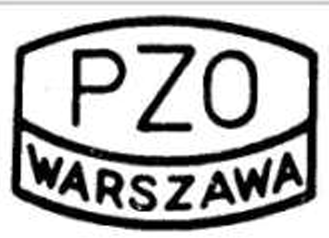
On 29 May 1931, at a General Meeting of Shareholders, the factory was renamed Polskie Zakłady Optyczne S.A. (PZO) — Polish Optical Factory. Two factors drove the change: Henryk Kolberg sold his shares, and the global economic crisis (1929–1933) had drastically reduced MOD budgets and binocular orders.
Kolberg's shares were acquired by three French companies: Optique et Précision de Levallois (OPL), Société des Établissements Krauss (SEK), and Factories Barbier, Bernard et Turenne. Critically, PZO remained a private joint stock company until the very last day before its evacuation in September 1939 — claims of earlier nationalisation are contradicted by primary sources.
The Second H.Kolberg: A Collector's Pitfall
Here lies a significant identification challenge. After selling his shares in the original company, Henryk Kolberg established a new venture on 28 September 1933: H.Kolberg i S-ka z o.o. (limited liability company), registered at 22 Chocimska Street, Warsaw. This second company became a direct competitor to PZO, producing identical 6×30 binoculars under the same MOD technical parameters (specification No. 520096).
The second H.Kolberg produced approximately 2,600 binoculars for the MOD between 1937 and 31 August 1939, with serial numbers beginning at 80,003 (after two prototypes numbered 80,002 and 80,003).
H.Kolberg i S-ka z o.o. Production (1937–1939)
| Period | Serial Number Range |
|---|---|
| 1937 – 31 March 1939 | 80,003 – 81,203 |
| April 1939 | 81,204 – 81,503 |
| May 1939 | 81,504 – 81,803 |
| June 1939 | 81,804 – 82,003 |
| July 1939 | 82,004 – 82,304 |
| August 1939 | 82,305 – 82,605 |
| 1–5 September 1939 | 82,600 – ~82,754 |
Serial number 29,763 – ~52,443: PZO (1931–1939)
Serial number above 80,000: H.Kolberg i S-ka z o.o. (limited liability, 1937–1939)
The eagle emblem also helps. Pre-1928 eagles feature a cross on the crown. Post-December 1927 eagles have no cross and differently shaped wings — following a presidential decree redesigning the national emblem.
The War Years: OPW, "eug," and the Partisan Raids
On 6 September 1939, both PZO and H.Kolberg i S-ka were ordered evacuated to Lvov. The plan was to continue production at the Jan Bujak factory there, but Lvov fell — not to the Germans, but to the Soviet army. Evacuated equipment, including finished instruments, was confiscated by Soviet forces. Workers returned to Warsaw.
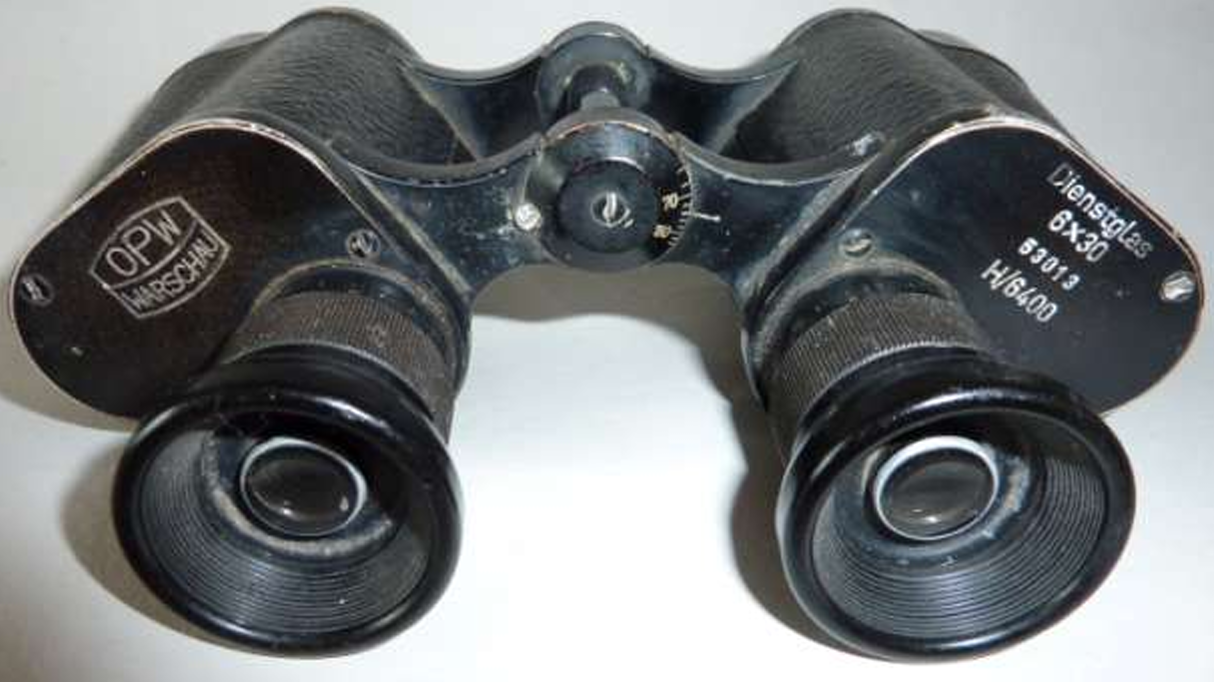
The Germans renamed PZO as "Optische Präzisions-Werke GmbH" (OPW) from October 1939, operating it as a Carl Zeiss Jena affiliate. Binoculars produced under this regime were marked "OPW" until May 1941, when the marking was changed to the German wartime manufacturer's code "eug." The binocular model itself was modified from the pre-war design. In August 1944, the Germans evacuated all machinery to a Carl Zeiss subsidiary in Czechoslovakia (present-day Teplice-Šanov), then destroyed the PZO factory buildings in September 1944.
The second H.Kolberg factory continued producing binoculars for the Wehrmacht throughout the occupation under its original name. In a remarkable act of resistance, around 600 binoculars were seized from the factory by Polish partisans in July 1944, just before the Warsaw Uprising. A separate Home Army cell within the factory, led by engineer Jan Łabuda and inspection manager Zygmunt Mączyński, organised the capture of approximately 500 additional binoculars from Wehrmacht transport convoys leaving the factory — redirecting them to the Polish underground military.
Survival & Rarity
Assessing how many pre-war binoculars survive is inherently speculative. Combined production from both factories totalled roughly 57,750 units. At the outbreak of war, approximately 150,000 officers were mobilised — meaning the binoculars were never produced in sufficient numbers to equip the entire officer corps. The MOD ordered that all equipment, including binoculars, be destroyed before surrender or after a lost engagement. Thousands of Polish officers were murdered by Soviet forces in the Katyń massacres of 1940; some binoculars have reportedly been found in mass graves.
The rarest examples are the earliest H.Kolberg S.A. production from 1924 (serials 11–1,000), the final days of PZO production from early September 1939, and any binoculars from the small H.Kolberg z o.o. run — of which fewer than 2,800 were ever made. The Vacani collection includes serial number 82,568, brought back from Russia, which represents the very late production of the second H.Kolberg company.
A Chronological Summary for Collectors
| Period | Name & Marking | Notes |
|---|---|---|
| Oct 1921 | H.Kolberg i S-ka S.A. | Founded at Leszno St., Warsaw |
| Jun 1923 | H.Kolberg i S-ka S.A. | Moved to 35 Grochowska St. |
| 1924–1931 | H.Kolberg i S-ka S.A. | 6×30 production, serials 11–29,762 |
| 29 May 1931 | PZO Warszawa | Name changed; French shareholders enter |
| 1931–1939 | PZO Warszawa | 6×30 production, serials ~29,763–52,443 |
| Sep 1933 | H.Kolberg i S-ka z o.o. | Second company at 22 Chocimska St. |
| 1937–1939 | H.Kolberg i S-ka z o.o. | 6×30 production, serials 80,003–~82,754 |
| Oct 1939 | OPW (Optische Präzisions-Werke) | PZO renamed under German occupation |
| May 1941 | "eug" code | OPW marking replaced with wartime code |
| Sep 1944 | — | Factory destroyed by retreating Germans |
| Jul 1945 | PZO (state-owned) | Rebuilt as government factory; no WP or eagle |
What to Look For
For collectors evaluating a Polish 6×30, the key diagnostic features are the serial number (which places the instrument in time and identifies the manufacturer), the style of the Polish eagle (cross on the crown for pre-1928, crownless for post-1928), the presence of "WP" markings (exclusive to pre-war H.Kolberg and PZO), the type of body covering (vulcanite imitation leather), and the dioptre scale integrated with the eyepiece focusing ring. The one-piece dioptre/focusing ring is absent on wartime OPW and "eug" examples, making it a definitive separator between pre-war and occupation-era production.
Cases were manufactured by A. Chojecki in Warsaw. Early H.Kolberg cases featured a strap wrapped around the case; later PZO cases (from 1931) were produced in light brown leather, embossed with the year of manufacture and PZO identification. Civilian-market cases differed slightly in design from military-issue examples.
These binoculars were built to last. The Vacani research notes that across all examined examples — some approaching ninety years of age at the time of writing — none had been found out of collimation, and the cementing of optical elements remained exceptionally strong. That mechanical integrity, combined with a production history intertwined with Poland's struggle for sovereignty, occupation, and resistance, makes the H.Kolberg and PZO 6×30 one of the most historically resonant pieces of interwar military optics a collector can hold.
This article is adapted from original research by Anna Vacani MA (June 2010). All serial number data derives from primary documents including the 1935 PZO Report No. 207 and archives of the Polish Institute and Sikorski Museum, London. Readers with additional information about surviving examples are encouraged to contact Collectors Archive.
Collectors Archive · Militaria · Optics · Field Equipment