The Last of Poland's Eagles: Serial No. 83448 and the Final Days of Polish pre-WWll Military Optics
March 24, 2026
Optics & Field Equipment · Collectors Archive
Serial No. 83448 doesn't appear in any production ledger. The ledgers didn't make it out of Poland.
What we know about pre-war Polish binocular production comes almost entirely from a single document — a classified factory report dated October 1935, marked TAJNE (Secret), that somehow survived the war in the archives of the Polish Institute and Sikorski Museum in London. Everything else was destroyed: the Warsaw factories, the records, most of the instruments. The 1935 report, reconstructed and published by Anna Vacani MA in 2010, lets us read the serial numbers as a timeline. Which is why 83448 is such an odd number to encounter.
It doesn't belong to any known production run.
Reading the Markings
Pick up any pre-war Polish 6×30 and the stampings tell you most of what you need to know, if you know what to look at.
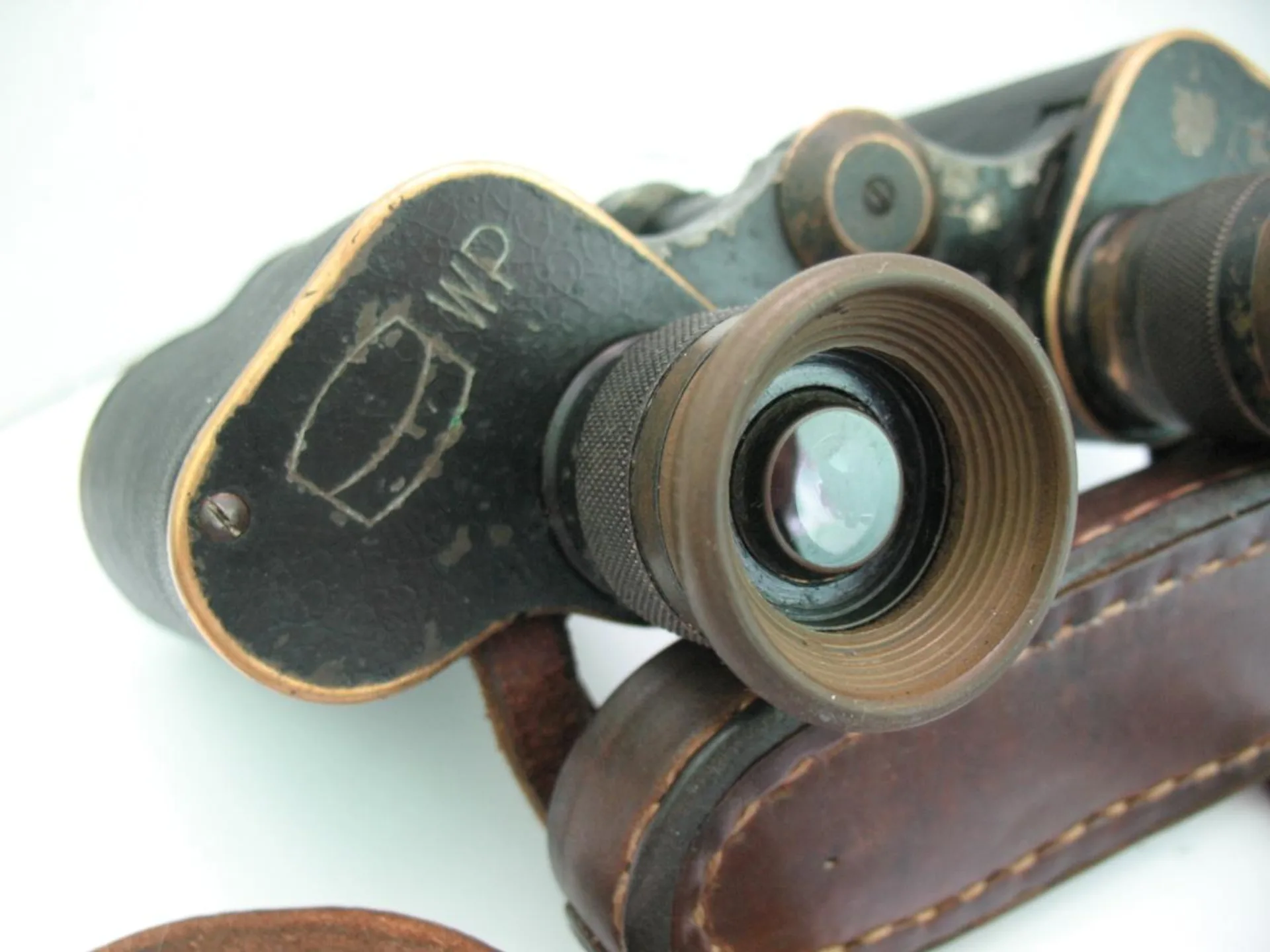
The left prism plate carries the manufacturer's cartouche — an engraved shape that follows the outline of an achromatic objective lens, which is a nice touch for an optics factory. Until May 1931 it reads H.Kolberg i S-ka Warszawa. After the company was renamed, PZO Warszawa. Either way, the letters WP sit beside it: Wojsko Polskie, Polish Army. These are the only Polish binoculars ever officially marked for military service this way. No other Polish optical factory used the WP designation.
The right plate has the specification oval — 6×30 above the serial number — and the Polish eagle. The eagle is worth looking at carefully. Poland changed the official design of the national emblem on 13 December 1927: the pre-1927 eagle wears a crown with a cross on top; the post-1927 eagle has a plain crown, differently proportioned wings, a cleaner overall silhouette. If you have a Kolberg with a cross on the crown and a serial below roughly 10,000, it's consistent — that puts it in 1924–1926 production. If the eagle and the number don't match, something is wrong with the piece.
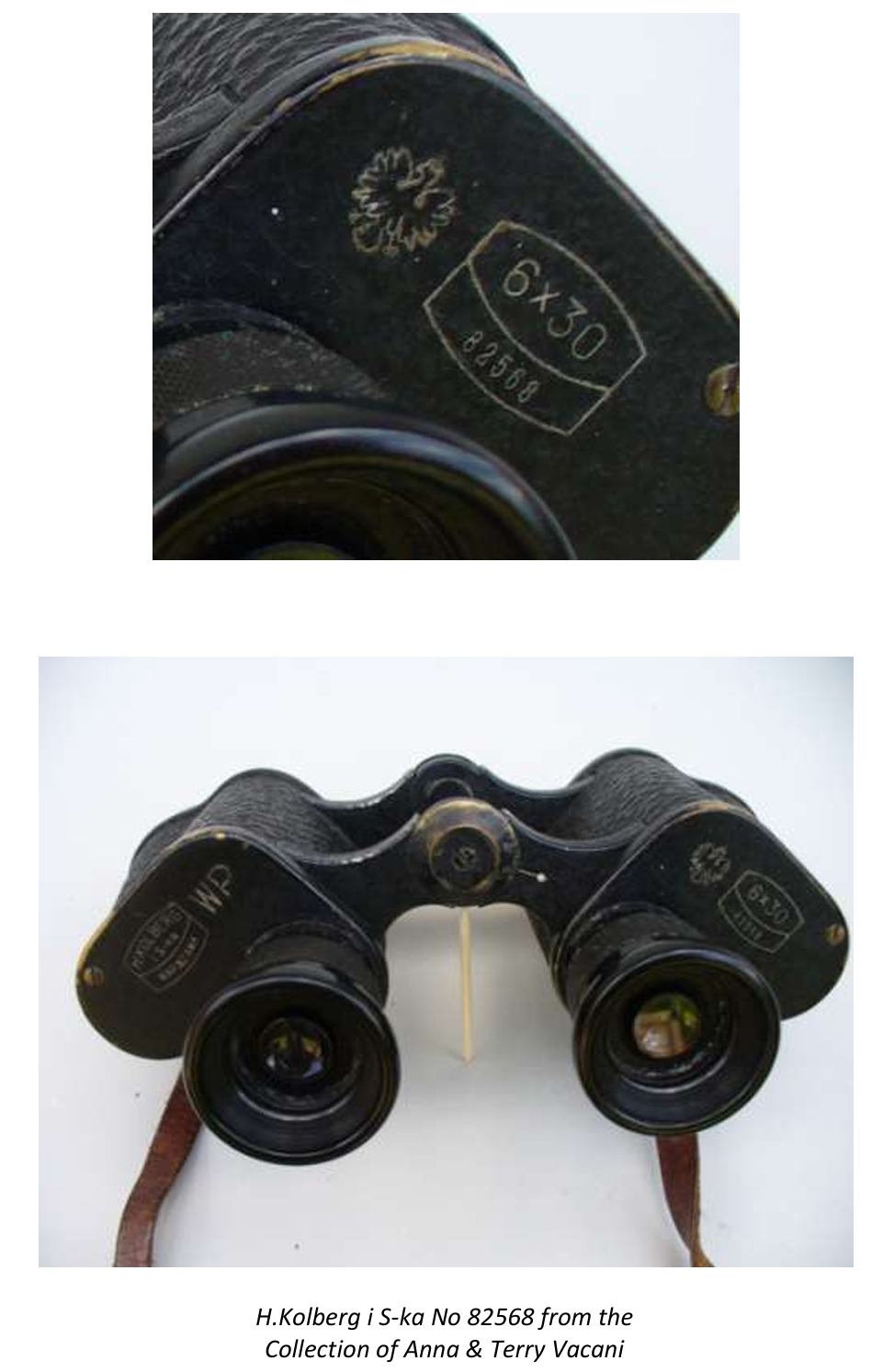
The third variable is the serial itself. H.Kolberg S.A. ran from 11 to 29,762 across 1924–1931. PZO continued from 29,763, reaching approximately 52,443 by early September 1939. The second H.Kolberg — a separate limited liability company Henryk Kolberg quietly opened in 1933, two years after selling his shares in the original — ran its own parallel series starting at 80,003, reaching around 82,754 before the evacuation order came through.
Those are the known ranges. 83448 sits above all of them.
Five Days in Warsaw, Then Lviv
Warsaw, September 1939. The German invasion had begun on the 1st, but PZO kept the line running. By the 5th, production effectively stopped. The following day, the military issued evacuation orders to all optical manufacturers: pack everything, head east to Lwów, report to the Jan Bujak precision instruments works, resume production there.
The move took until the 11th. Machinery, tooling, partially assembled instruments, workers — all of it loaded and transported across a country already at war.
The plan collapsed almost immediately. Wehrmacht units reached the outskirts of Lwów on the 12th. The city held out, but the situation was deteriorating. Then, on 17 September, the Soviet Union invaded Poland from the east — the consequence of the Molotov-Ribbentrop Pact signed seven weeks earlier. Lwów, now threatened from two directions, fell to the Red Army on 22 September.
In the eleven days between the factory's arrival in Lwów and the Soviet capture of the city, workers assembled what they could from the transported parts. How many instruments? The records don't say. The Soviet Army confiscated the equipment along with everything else from the Polish state that crossed into their occupation zone. Most of what was assembled in those eleven days vanished into Red Army supply chains.
The Instrument
Serial 83448.
The number clears the top of the H.Kolberg z o.o. Warsaw series (82,754) by nearly 700 units. There's no production accounting for it in Warsaw — both factories had stopped by then. The only context that makes sense of this number is the Lwów period: parts transported from Warsaw, a bench somewhere in the Jan Bujak works, eleven days between arrival and capitulation.
The binocular survives in original condition with its carrying case. The case is Soviet issue — not Polish. That's the most direct evidence of what happened to it: assembled under Polish hands in a city about to fall, confiscated within days, issued to a Red Army soldier, carried through the war. The Soviet case is not damage to the provenance. It is the provenance.
The markings on the right plate show the established post-1927 format — eagle, specification oval, serial number — but anyone who has handled a quantity of PZO production will notice something is slightly off. The engraving quality is not what you expect from Grochowska Street in the mid-1930s. The cartouche borders are there, the eagle is legible, the number is clear. But the execution has the character of work done with transported tooling in a borrowed space, by people who knew the city they were working in was being shelled. It is, in a word, rushed. Given what we know of the circumstances, that's exactly what it should be.
On Rarity
There are perhaps a handful of instruments from the Lwów period still in existence. Most were consumed by the war. The Soviet-pattern case on 83448 is precisely why this one survived — Red Army equipment was maintained, stored, documented to a degree that the chaotic retreat of the Polish forces never allowed. The instrument was cared for because it was useful, not because anyone understood what it was.
PZO production for the Ministry of Defence across the entire pre-war period totalled approximately 60,000 instruments. Of those, an unknown number were destroyed in the September campaign on explicit orders (Polish regulations required the destruction of optical equipment before surrender or capture). Thousands more were lost at Katyń and the other massacre sites — Polish officers' personal equipment, buried with them. What remains in collections today is a fraction of total production, and Lwów-period assembly represents a fraction of a fraction.
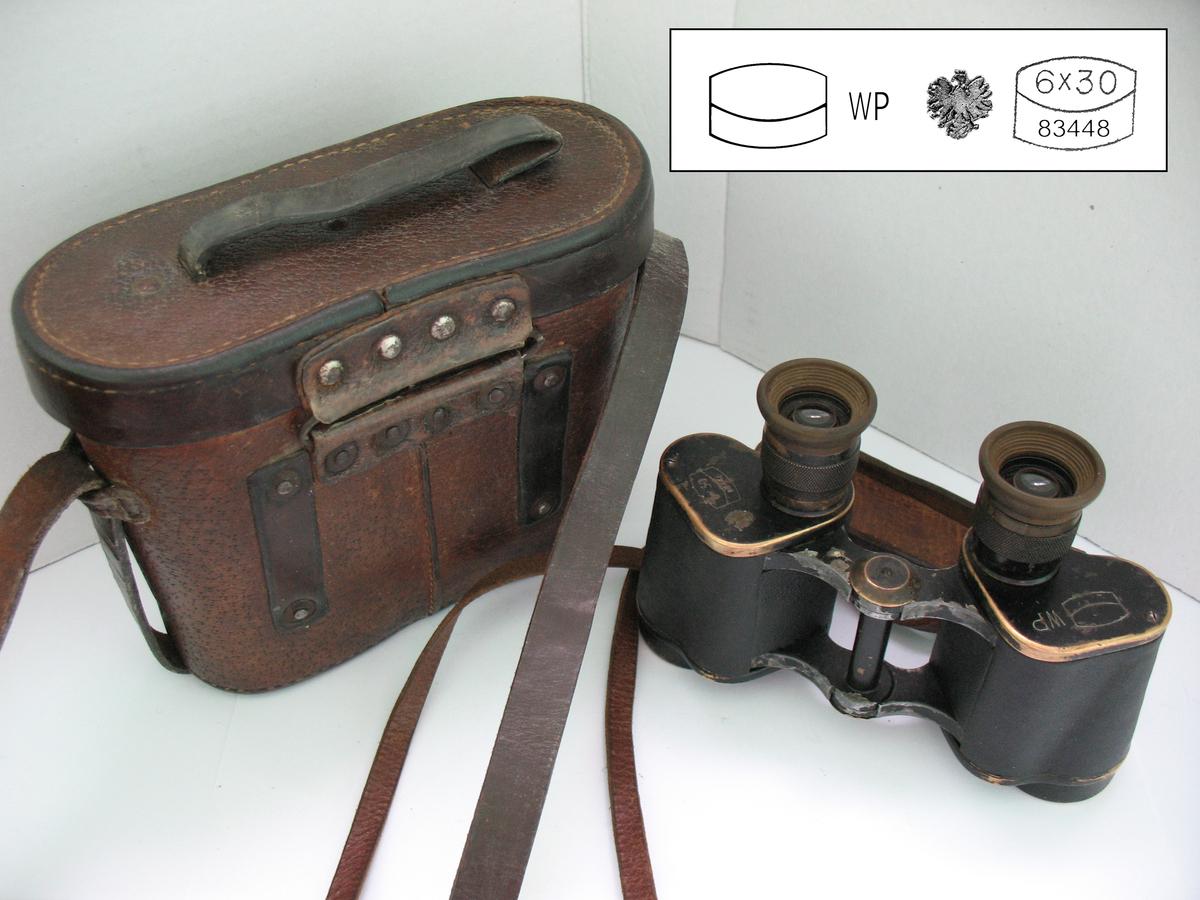
Set of presumably the last manufactured 6x30 WP binoculars
A serial number above 83000 is not a variant. It is a different category of object entirely.
Quick Reference: Polish 6×30 Production
| H.Kolberg S.A. | PZO | H.Kolberg z o.o. | Lwów, Sept. 1939 | |
|---|---|---|---|---|
| Years | 1924–1931 | 1931–1939 | 1937–1939 | Sept. 6–22, 1939 |
| Left plate | H.Kolberg i S-ka Warszawa | PZO Warszawa | H.Kolberg i S-ka Warszawa | WP only |
| Serials | 11 – 29,762 | 29,763 – ~52,443 | 80,003 – ~82,754 | ~82,755 onwards |
| Eagle | Pre- or post-1927 | Post-1927 | Post-1927 | Post-1927 |
| Case | Dark leather, early Polish military | Light brown, PZO-stamped | Polish military | Soviet-issue |
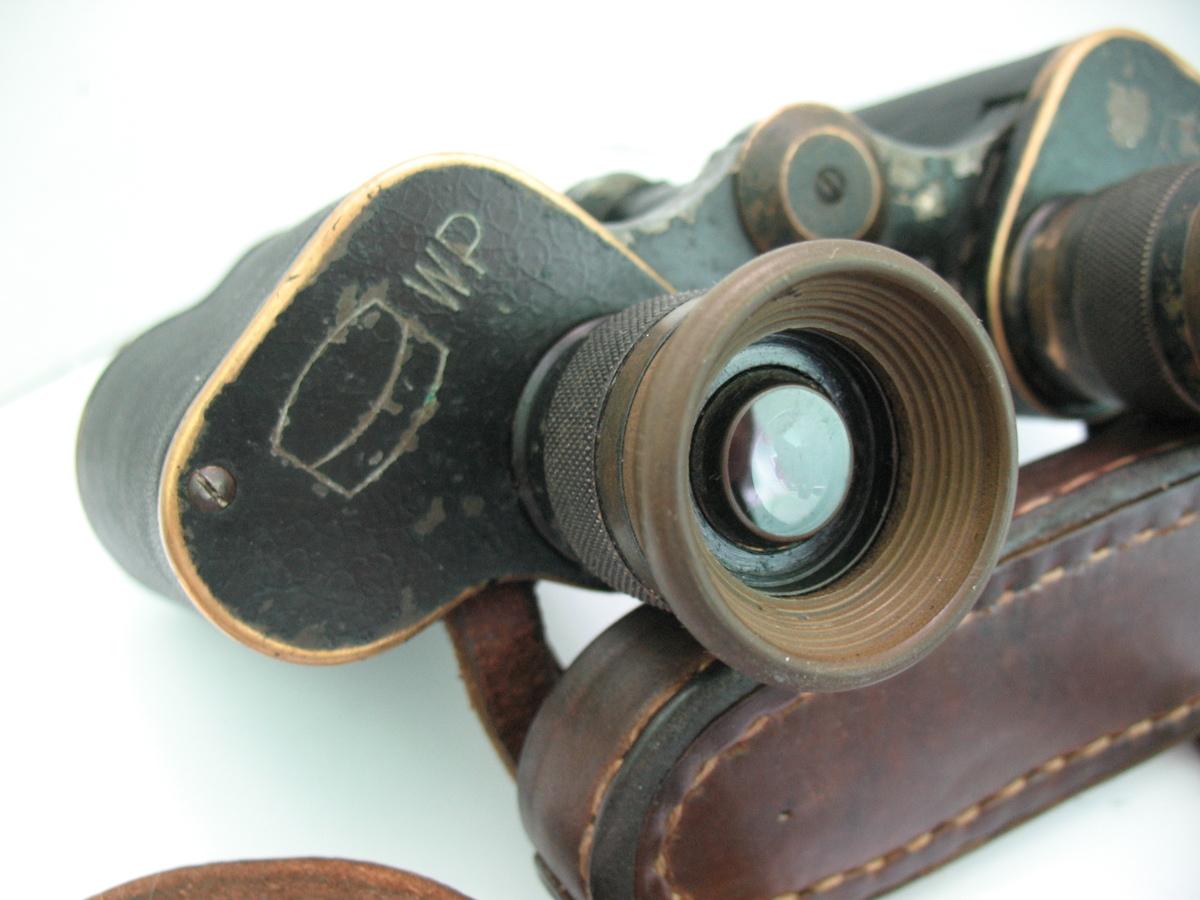
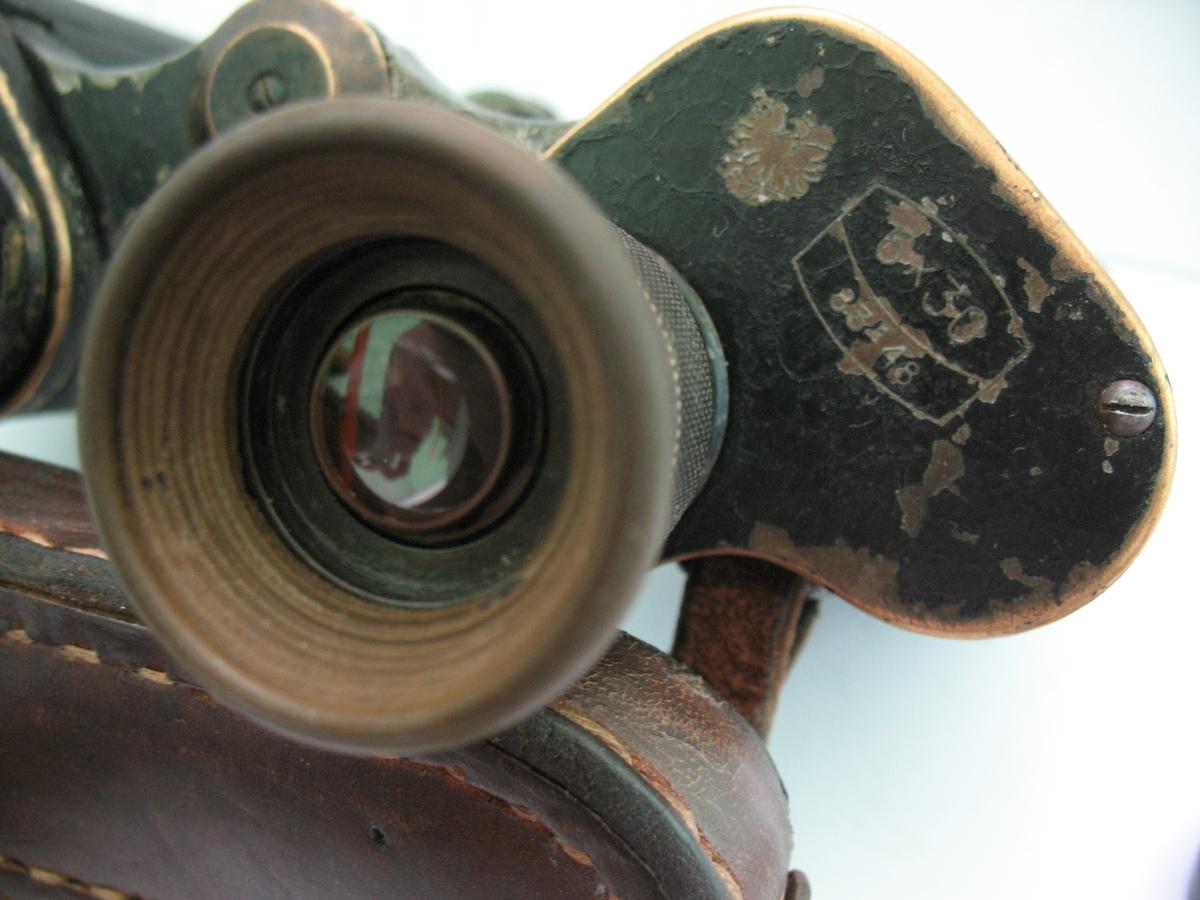
Left and right cup of the model - see the blank space where the manufacturer name should have been.
Sources
The serial number reconstruction in this article follows the framework established by Anna Vacani MA in The History of 6×30 Binoculars H.Kolberg i S-ka and PZO (2010), drawing on Dr Piotr Matejuk's Wojskowe Przyrzady Optyczne w II Rzeczpospolitej (1997), archives of the Polish Institute and Sikorski Museum, London, the Central Military Archives of Poland, and research by Dr Wolfgang Wimmer of the Carl Zeiss Archiv Jena. The interpretation of serial 83448 as Lwów-period production is the author's, based on those ranges.