Polish Naval Binoculars 6×30 by PZO Warszawa — A Pre-War Rarity for the Marynarka Wojenna
March 30, 2026
The Instrument
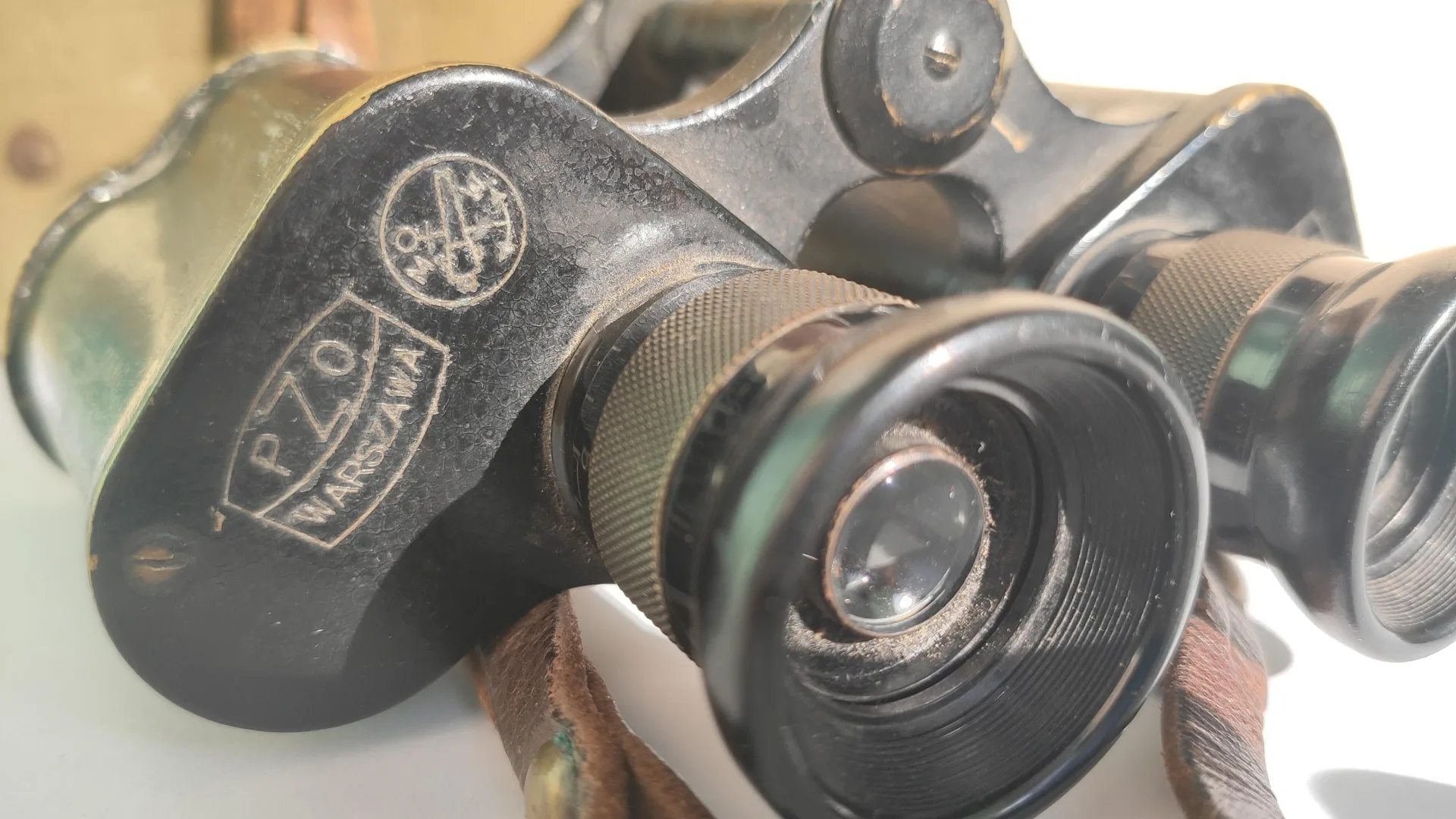
What we have here is a genuine pre-war Polish military binocular, manufactured by Polskie Zakłady Optyczne (PZO) in Warsaw — serial number 51466 — and bearing the anchor-in-circle emblem of the Polish Navy (Marynarka Wojenna). This is not your standard army-issue PZO 6×30. The naval anchor stamp, in place of the usual "WP" (Wojsko Polskie) marking and Polish eagle found on army models, makes this a considerably scarcer variant.
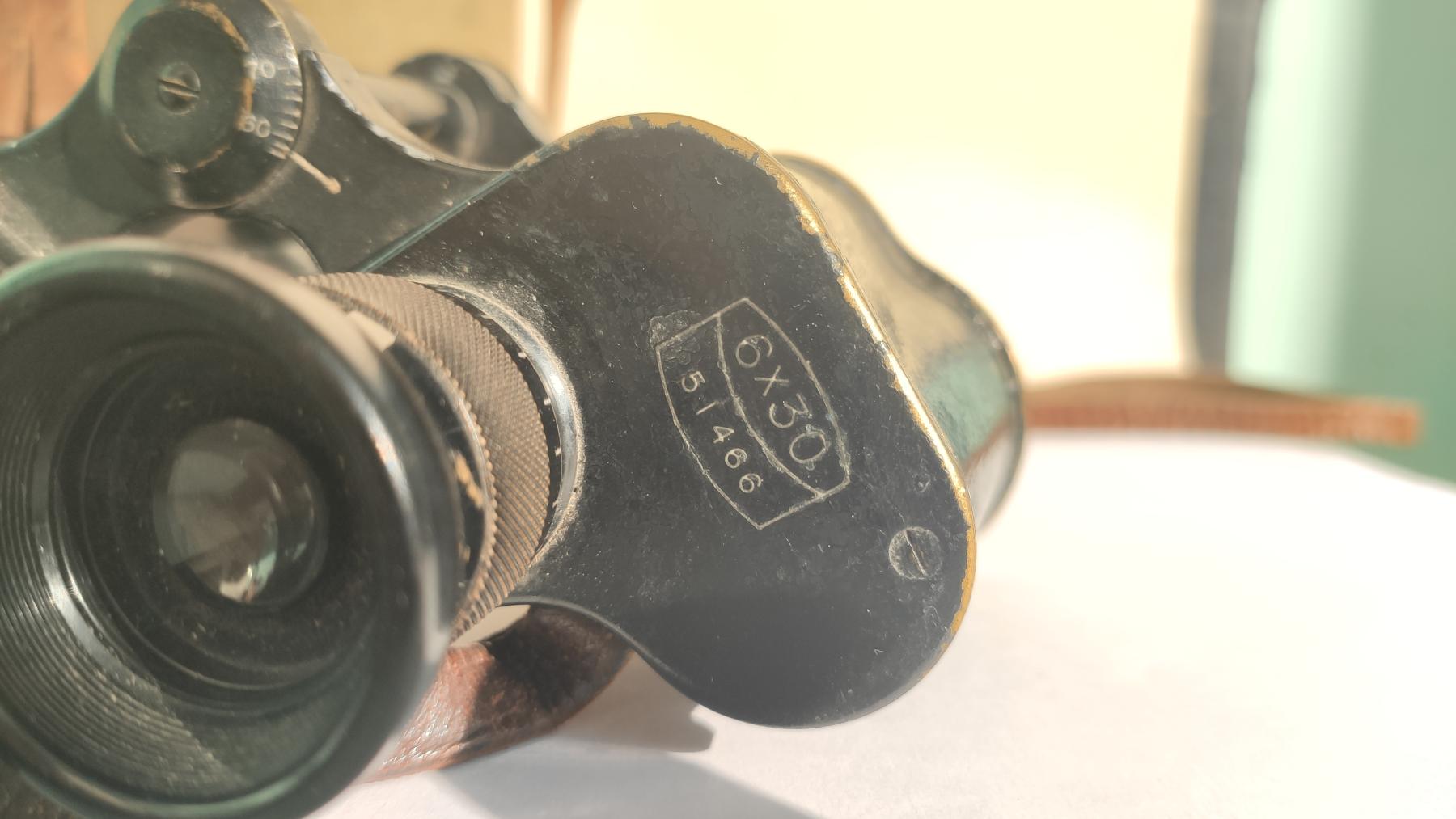
The body is finished in the characteristic PZO black anti-corrosion lacquer over an aluminium alloy casting, with the vulcanite-type imitation leather covering that PZO was known for — a material that, by all accounts, outlasted the coverings used by many Western European makers of the period. The left plate carries the "PZO WARSZAWA" manufacturer's cartouche, while the right plate displays the model designation "6×30" and the serial number 51466, both within the familiar shield-shaped escutcheon. Above the manufacturer's mark sits the naval anchor acceptance stamp.
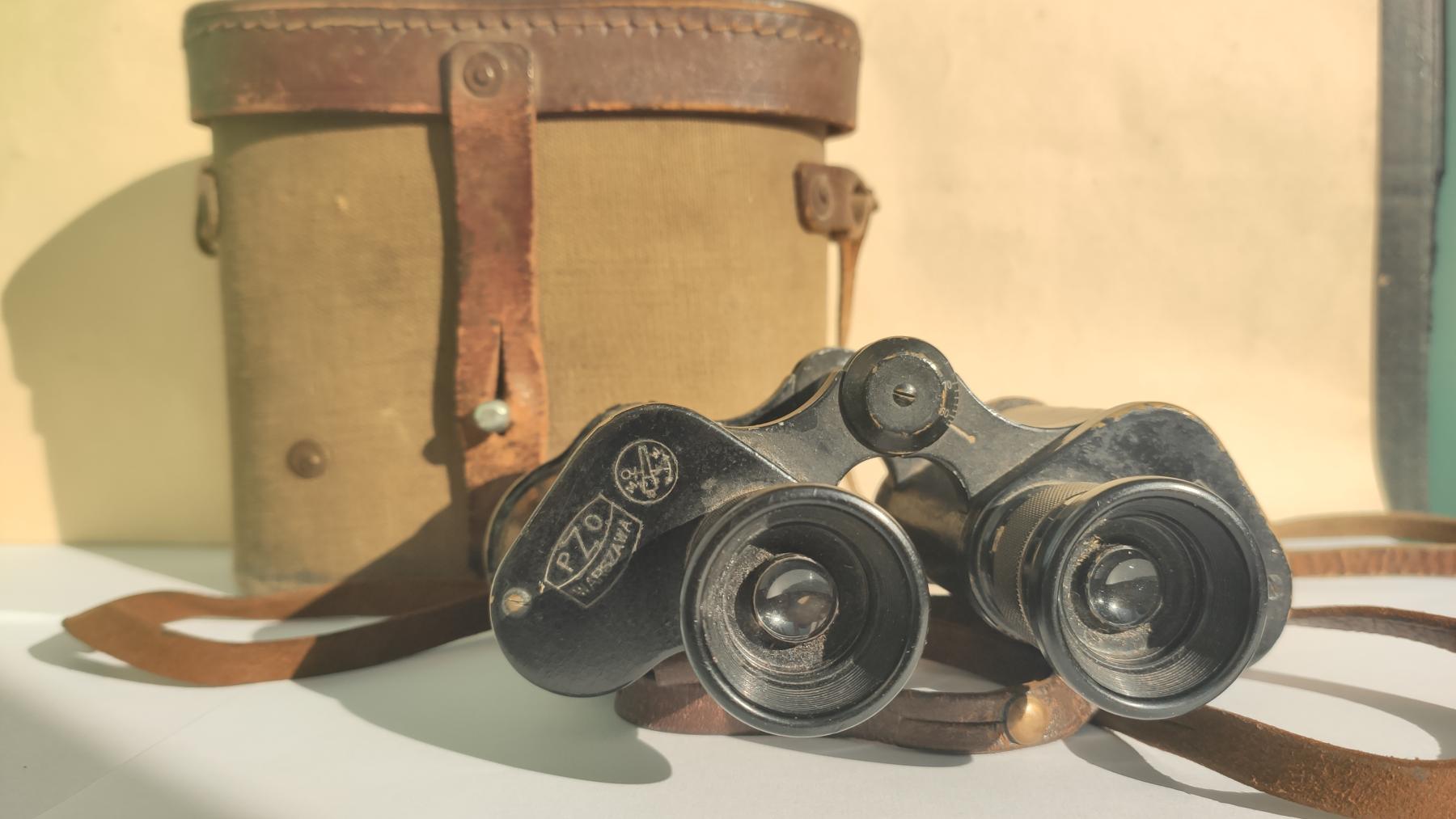
This is a Porro-prism instrument with individual eyepiece focusing — each ocular has its own dioptre adjustment ring. This is the standard military configuration, distinct from civilian binoculars of the era which typically employed a central focusing wheel with a hinged bridge. There is no central focus mechanism on this instrument. The brass strap lugs and original leather neck strap are present and intact.
Dating by Serial Number
The serial number is the key to dating any PZO binocular with confidence. According to the production tables compiled by Anna Vacani from original PZO factory documents (specifically the PZO Report No. 207 of October 1935 and records held at the Polish Institute and Sikorski Museum in London), the serial number ranges for PZO 6×30 production run as follows:
| Year | Serial Number Range |
|---|---|
| 1931 (from May) | 29,763 – 30,400 |
| 1932 | 30,401 – 32,121 |
| 1933 | 32,122 – 36,072 |
| 1934 | 36,073 – 39,300 |
| 1935 | 39,301 – 42,689 |
| 1936 | 42,690 – 46,090 |
| 1937 | 46,091 – 48,091 |
| 1938 | 48,092 – 50,092 |
| 1939 (to 4–5 September) | 50,093 – 52,443 |
Serial number 51,466 falls squarely within the 1939 production range — placing this binocular among the very last instruments produced by PZO before the German invasion of Poland on 1 September 1939. The factory was ordered to evacuate to Lwów on 6 September, effectively ending pre-war production. In total, PZO (including the earlier H. Kolberg i S-ka S.A. period) produced approximately 55,000 binoculars of this model for the Polish Ministry of Defence.
The Factory: From H. Kolberg to PZO
The story of this binocular begins not with PZO, but with the H. Kolberg i S-ka factory, established in Warsaw in October 1921 by Leon Małecki, Henryk Kolberg, and Kazimierz Karol Mieszczański. The firm's first contract with the Polish Ministry of Defence called for production of prismatic binoculars based on Russian technical documentation — specifically, construction drawings of a Russian 6× binocular (Zeiss-type) lent to the company by the MOD's Department III of Artillery and Armament.
Production began in 1924, with the design closely following the Zeiss Silvamar pattern. All optical glass came from the French firm Parra Montois or the German Schott company, as Poland had no domestic optical glass production at the time. The binoculars quickly earned a strong reputation: in trials at Fort Bragg (1929–1931) organised by the U.S. Army Headquarters of Field Artillery, the H. Kolberg binocular received top marks for brightness. The Americans even proposed an export contract, though negotiations fell through over pricing.
On 29 May 1931, following the sale of Henryk Kolberg's shares to French optical firms — Optique et Precision de Levallois (OPL), Société des Établissements Krauss, and Barbier, Bernard et Turenne — the company was renamed Polskie Zakłady Optyczne S.A. (PZO). The serial numbering continued without interruption; the logo changed, the binocular did not.
By the mid-1930s, PZO had become the backbone of Poland's military optics industry, producing 95% of the optical instruments required by the Polish armed forces. Beyond the 6×30 binocular, PZO manufactured dial sights, panoramic sights, range-finders, anti-aircraft fire control instruments, tank sights for the 7TP, and — critically for the context of this particular binocular — naval optical equipment, including fire control systems and periscope components produced under licence from the Dutch firm Nedinsco for Polish submarines ORP Orzeł and ORP Sęp.
The Naval Connection
Standard Polish Army binoculars carried the "WP" marking (Wojsko Polskie) alongside the Polish eagle. The anchor-in-circle stamp on this instrument identifies it as having been accepted for service with, or issued to, the Polish Navy (Marynarka Wojenna).
This raises an interesting historical question. In 1932, the Commander of Polish Naval Forces, Vice-Admiral Józef Unrug, declared that the 6×30 binoculars were unsuitable for naval night observation — insufficient light-gathering power, rapid eye fatigue, and excessive weight for maritime use. A three-year evaluation followed, comparing the British Barr & Stroud 7×50 and the French Krauss 7×50, with the Krauss model ultimately selected as superior for naval service in November 1935.
So why would a 6×30 binocular from 1939 carry a naval stamp? Several possibilities exist. First, the 7×50 models were expensive specialist instruments — not every sailor, shore installation, or coastal defence unit would have been issued one. The 6×30 remained perfectly serviceable for daytime observation, harbour duty, or secondary roles aboard smaller vessels. Second, with war imminent and full mobilisation underway in 1939, the Navy may have accepted whatever serviceable optics were available from PZO's final production runs. Third, the anchor stamp could have been applied post-war, when the reconstituted Polish Navy (Marynarka Wojenna Polskiej Rzeczypospolitej Ludowej) inventoried surviving pre-war equipment in the late 1940s or 1950s.
What is significant is the absence of any German or Soviet acceptance marks. Had this binocular been captured and reissued by the Wehrmacht, it would almost certainly bear German inspection stamps (the characteristic triangle mark). Its clean Polish markings suggest it remained in Polish hands — either evacuated with naval personnel or stored and later recovered.
Technical Specifications
| Parameter | Value |
|---|---|
| Manufacturer | PZO (Polskie Zakłady Optyczne), Warszawa |
| Model | 6×30 |
| Magnification | 6× |
| Objective diameter | 30 mm |
| Exit pupil | 5 mm |
| Light-gathering power | 25 |
| Field of view | approx. 8°–8.5° (≈150 m at 1,000 m) |
| Optical system | Porro prism |
| Focusing | Individual eyepiece (dioptre rings) |
| Body | Aluminium alloy casting |
| Covering | Vulcanite imitation leather |
| Weight (without case) | approx. 653 g |
| Serial number | 51,466 |
| Year of manufacture | 1939 |
| Service branch | Marynarka Wojenna (Polish Navy) |
The Wartime Fate of PZO
The broader context of this binocular's survival is worth understanding. When Poland was invaded in September 1939, the PZO factory at 35 Grochowska Street in Warsaw was evacuated to Lwów on 6 September, but the equipment was confiscated by the Soviet Army upon their occupation of eastern Poland. The workers returned to Warsaw, where the factory continued operating under German control as Optische Präzisions-Werke GmbH (OPW) from October 1939, and later under the wartime manufacturer's code "eug". The factory was managed as a Carl Zeiss Jena affiliate. Binoculars produced under occupation were markedly different from the pre-war PZO instruments — different markings, different context entirely.
In August 1944, the Germans evacuated the machinery to Czechoslovakia, and in September 1944, the factory buildings were demolished. PZO was rebuilt by the post-war government from July 1945 onward. Post-war PZO binoculars no longer carried the "WP" marking or the Polish eagle.
Collector's Notes
Pre-war PZO 6×30 binoculars in good condition are becoming increasingly difficult to find. Of the approximately 55,000 produced by PZO and its predecessor H. Kolberg, a great many were destroyed during the war — the MOD standing order was to destroy equipment before surrender. Thousands more were lost with the Polish officers murdered in the Soviet Union in 1940.
Naval-marked examples are considerably rarer than the standard army "WP" variant. The combination of a confirmed 1939 production date (from the final pre-war serial range), the naval anchor stamp, and the intact original PZO markings without any foreign re-stamping makes this a noteworthy piece for any serious collection of Polish military optics or WWII-era binoculars.
Sources: Anna Vacani MA, "The History of 6×30 Binoculars H. Kolberg and PZO" (June 2010); Dr Piotr Matejuk, "Wojskowe Przyrzady Optyczne w II Rzeczpospolitej" (1997); PZO Report No. 207 (October 1935); records of the Polish Institute and Sikorski Museum, London; Central Military Archives, Warsaw.
Collectors Archive — specialist dealers in military antiques and optics.